Tuesday, 22 May 2012

Invalid Class String

Occasionally, you get error messages from Endnote.

Unfortunately they are sometimes less than informative.

A case in point is when you get an error message saying ‘Invalid Class String’.

There are a few possibilities here:

You may be running Word and Endnote at different levels of permissions (e.g. Word as Administrator and Endnote as a user). This seems to confuse matters.

You may be running a different version of Endnote to that installed as the cite while you write tools in Word. The answer here is to reinstall the tools in the correct version.

Fixes, depending on your versions of Word and Endnote, can be found here:


Tuesday, 15 May 2012

Endnote Training Videos on You Tube


Just to draw your attention to the Endnote You Tube channel:


This contains over 50 videos of Endnote training, including quick start lessons, downloading from databases and some more obscure bits like the importance of the .DATA folder.

The only problem I can see with them is that some are a little out of date, like the JSTOR video. JSTOR changed their interface recently; this is the problem with this sort of documentation: it goes out of date quite rapidly.

Still, worth a look, and they are nice, and useful, videos.

Tuesday, 8 May 2012

Displaying Multiple Authors


You may have found that later versions of Endnote (X5 in particular) displays by default all the authors of a multi-author reference.

You may find this slightly annoying, as I do, because the column in the display is too narrow and so the additional information is wasted.

Furthermore, the initials of the authors are displayed, and this can be inconsistent in the references. In extreme cases you can get one author with last name then initials displayed, and then the next reference has last name and full first names. This looks a bit confusing, in my view.


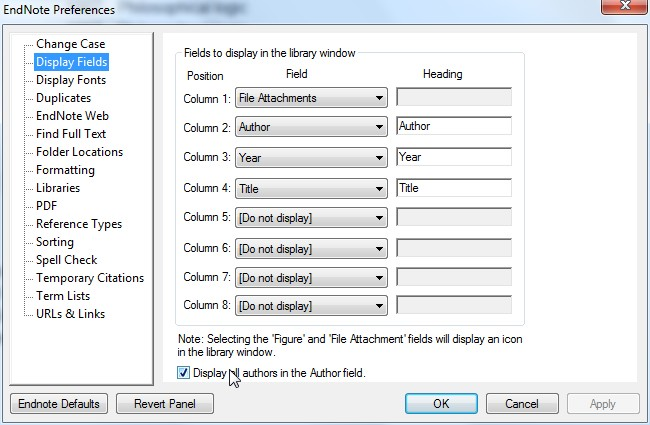
There is a fairly easy fix for this one, found on Edit | Preferences and choose the Display Fields link.


Click on the checkbox at the bottom to switch off the all author display. Click Apply and OK, and the display should look neater.


Tuesday, 1 May 2012

Importing PDFs


It is possibly a little known fact, but you can import PDFs into you Endnote library and, in some cases, Endnote can get the bibliographical detail from the headers in the PDF.

It has to be said that this will only work with reasonably recent PDFs.

To import, choose File | Import | File from Endnote.


The Import File dialog is shown.


Click on Choose… to select the PDF of interest, and make sure you have PDF selected in the Import Option drop down menu.


Click on Import.

A number of windows might appear as Endnote imports and analyses the file. The item should then appear in your Imported References group, with the PDF attached.


Tuesday, 24 April 2012

Zotero 3.0

I occasionally get accused of being an Endnote evangelist, and being so zealous for the Endnote cause that I ignore its shortcomings and any competitors.

I hope that is not true, but Endnote is the product we have within the university, and it is, in my view, the most powerful and flexible of the products available. That does not mean that it suits everyone, of course, and power and flexibility come at a price, both in financial terms and in complexity.

Therefore, I want to flag up one of the main Endnote competitors today, which has recently undergone a makeover: Zotero 3.0.

Earlier versions of Zotero have, in my view, been hamstrung by the fact that it has to be run from within the Firefox browser. Now, it may just be me, but I’ve found Firefox to be a bit slow and clunky, which has made Zotero harder to use.

Zotero 3.0 comes in a stand alone version, which is good, in my view, and it also integrates with Google Chrome and Safari, which as the former is currently my browser of choice, is a good thing.

You can download Zotero 3.0 standalone from here: http://www.zotero.org/support/3.0#zotero_standalone

It will read your older Zotero files, and you can export and import from Endnote as well, via RIS format libraries.

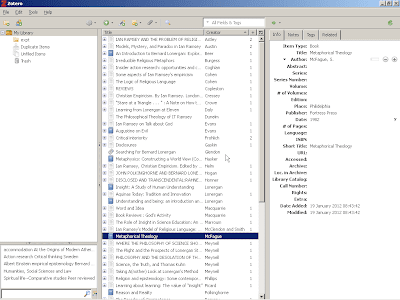
Once installed and launched, Zotero looks like this:

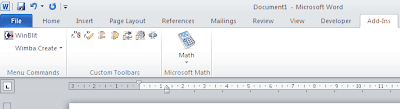
The toolbar in Word 2010 looks like this:

I’ll try to write a few posts over the next few weeks explaining how to use the software. In the meantime, there is a comparison of the products here:

http://chronicle.com/blogs/profhacker/zotero-vs-endnote/33157

Zotero also works in Mendeley, which I know some folk use; in fact, I believe that it is part of the underlying code for Mendeley, but I could be wrong on that.

Tuesday, 17 April 2012

Activating Templates

Sometimes, last week’s solution to non-appearing Endnote tools does not work.

This seems to be because Word, somehow, has decided to de-activate the Endnote templates.

Unfortunately, this works in different ways on different Word installations. The instructions below are for Word 2010.

In Word 2007, it is similar but the Word Options are to be found on the big Office button.

In Word 2003, the Templates and Add-Ins dialog is to be found on the Tools menu item.

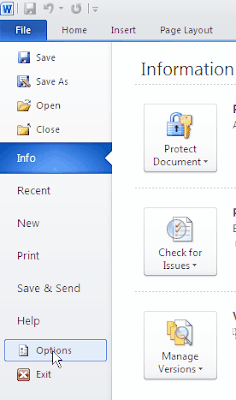
In Word 2010, go to File | Options


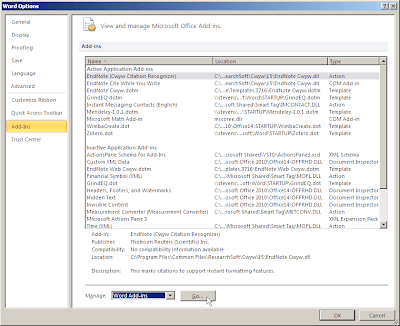
Choose the Add-Ins area.

If the Endnote templates are active (as above) they will be listed in the top part of this dialog.

If not, then go to the Manage menu at the bottom of the dialog and choose Word Add-Ins.

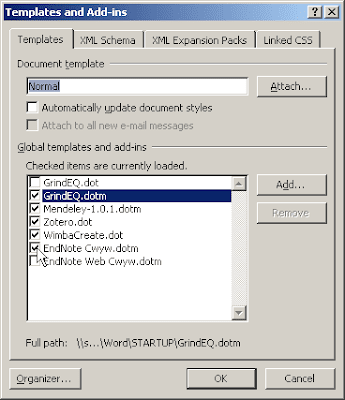
Click on Go, and the list of templates will be displayed.

Activate Endnote Cwyw.dotm by checking the box to the left of the name. Click on OK and the Endnote tools should appear.

Test Video


This is a test of a video of some Endnote functionality, just to see if it can be done.