Tuesday, 24 April 2012

Zotero 3.0

I occasionally get accused of being an Endnote evangelist, and being so zealous for the Endnote cause that I ignore its shortcomings and any competitors.

I hope that is not true, but Endnote is the product we have within the university, and it is, in my view, the most powerful and flexible of the products available. That does not mean that it suits everyone, of course, and power and flexibility come at a price, both in financial terms and in complexity.

Therefore, I want to flag up one of the main Endnote competitors today, which has recently undergone a makeover: Zotero 3.0.

Earlier versions of Zotero have, in my view, been hamstrung by the fact that it has to be run from within the Firefox browser. Now, it may just be me, but I’ve found Firefox to be a bit slow and clunky, which has made Zotero harder to use.

Zotero 3.0 comes in a stand alone version, which is good, in my view, and it also integrates with Google Chrome and Safari, which as the former is currently my browser of choice, is a good thing.

You can download Zotero 3.0 standalone from here: http://www.zotero.org/support/3.0#zotero_standalone

It will read your older Zotero files, and you can export and import from Endnote as well, via RIS format libraries.

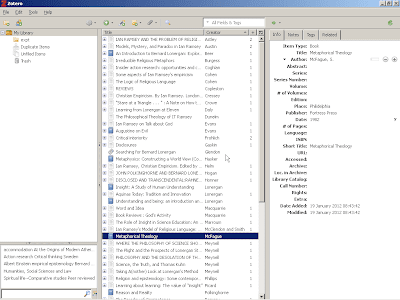
Once installed and launched, Zotero looks like this:
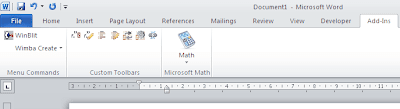
The toolbar in Word 2010 looks like this:

I’ll try to write a few posts over the next few weeks explaining how to use the software. In the meantime, there is a comparison of the products here:

http://chronicle.com/blogs/profhacker/zotero-vs-endnote/33157

Zotero also works in Mendeley, which I know some folk use; in fact, I believe that it is part of the underlying code for Mendeley, but I could be wrong on that.

Tuesday, 17 April 2012

Activating Templates

Sometimes, last week’s solution to non-appearing Endnote tools does not work.

This seems to be because Word, somehow, has decided to de-activate the Endnote templates.

Unfortunately, this works in different ways on different Word installations. The instructions below are for Word 2010.

In Word 2007, it is similar but the Word Options are to be found on the big Office button.

In Word 2003, the Templates and Add-Ins dialog is to be found on the Tools menu item.

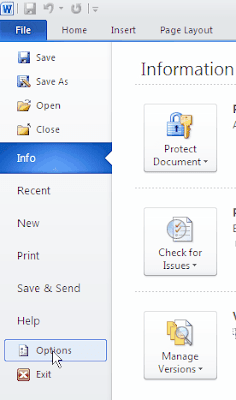
In Word 2010, go to File | Options


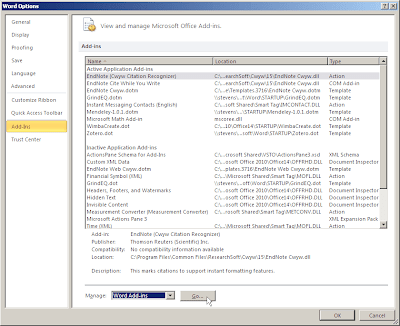
Choose the Add-Ins area.

If the Endnote templates are active (as above) they will be listed in the top part of this dialog.

If not, then go to the Manage menu at the bottom of the dialog and choose Word Add-Ins.

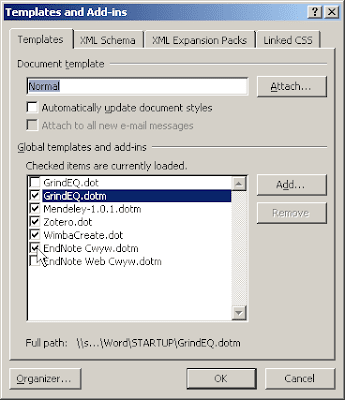
Click on Go, and the list of templates will be displayed.

Activate Endnote Cwyw.dotm by checking the box to the left of the name. Click on OK and the Endnote tools should appear.

Test Video


This is a test of a video of some Endnote functionality, just to see if it can be done.


Tuesday, 10 April 2012

Endnote Add-Ins

Recently, a few people have contacted me with problems relating to Endnote Add-Ins.

Sometimes, Endnote can simply disappear from your Word installation, or simply not appear at all on installation.

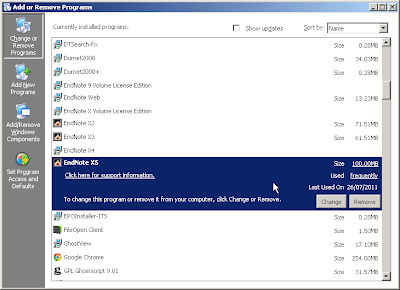
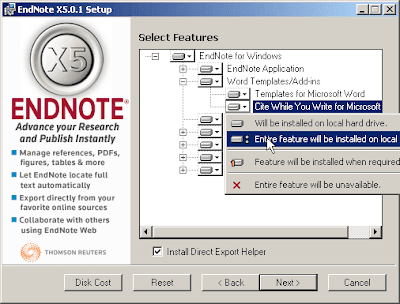
The usual advice is to reinstall Endnote. From Control Panel | Add or Remove Programs choose your Endnote program and click on Change:

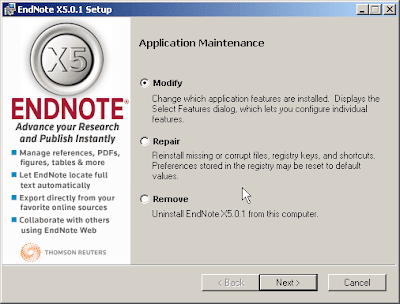
The Endnote installer will launch. Choose Modify.

Click on Next. From the options choose ‘Endnote Program and then Cite While You Write.

Click on the drop down menu and choose ‘Entire feature will be installed on local disk.

Click on Next, and in the next screen click next again. The Word part of Endnote (called Cite While You Write) should then be installed.

Tuesday, 7 February 2012

Downloading Extra Files

As I mentioned before, by default Endnote does not load all the style, connection and import files. On a PC, you can simply modify the installation to achieve the full loading (see http://durhamendnote.blogspot.com/2011/10/full-install-of-endnote-files.html for details), but I’m not sure how to do this on a Mac.

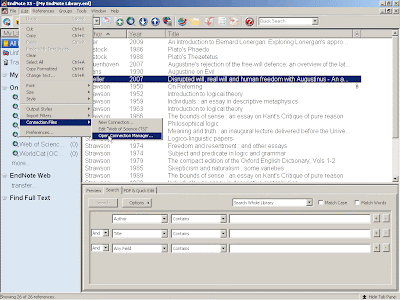
The easiest option seems to be to click on Edit and choose, for example, Connection files from the main Endnote window, then select ‘Open connection Manager’.


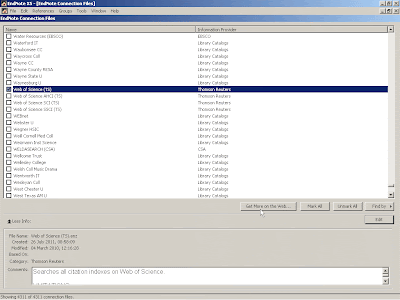
The Connection Manager dialog has a ‘Get More on the Web’ button. Click on this.


This takes you directly to the download page on the Endnote web site.


Click on the download a complete set link and put the file where the instructions (in slightly smaller type) suggest. You should then have the full set of connection files available in Endnote.

Tuesday, 31 January 2012

Library Modes

One thing that occasionally foxes people are the library modes. You may not ever have discovered them, but they can be disconcerting if you ever accidentally switch to one or other of them.

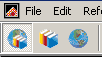
There are three library modes, and which you are in is controlled by the buttons to the top left of the user interface.

The one to the left puts Endnote into Integrated Library and Online Search Mode. This is the normal mode of operation.

The middle button puts Endnote into Local Library mode. There are no online search options in this mode, although you can import, find full text and direct download references into your library; you just cannot do a search from Endnote to a library.

The rightmost button puts endnote into Online Search Mode. Here, all you can do is search online, via Endnote. Any items you download are held in a temporary library and are discarded when you close, or switch modes. If you want to keep them, you will have to open another Endnote library and copy your items across.

I suppose the next question is ‘why have these modes?’

I think the answer is that in some circumstances, for example using Endnote as a medical librarian, you may get many, many references, particularly if your search is not terribly sophisticated. The online search mode operates as a filtering place for these references, allowing you to select only the references you are actually interested in.

But for most of us, Integrated Library and Online Search Mode is all we need.

Tuesday, 24 January 2012

Endnote and Travelling Libraries

I occasionally get asked about send Word documents with Endnote references to other people without Endnote.

This does work.

The reason it works is because the Word document carries with it what is called a ‘travelling library’, Essentially, Word packs all the information that Endnote gives it up into the document. Someone without Endnote reading the document does not see all the Endnote bits, but does see the references correctly formatted.

Now, as you may well already know, nothing is quite that simple, and occasionally things do go wrong. Also, if you are asked to submit plain text, you need to remove all the Endnote related bits of processing that go on to render the formatting of references.

You might know that Endnote inserts its information through things called ‘field codes’.

To remove the field codes, make sure you work on the final final copy of your manuscript. It is also advisable to make a back up copy of that.

To remove the field codes, use Control-A to select the whole document.

Then, hold down the control and shift keys and press F9. The field codes will be removed.

Your references and bibliography are now plain text.

Any modifications will need to be done in the original, and the same procedure followed.